Tech companies are collectively spending billions to turn the age old sci-fi trope of humanoid, general-purpose robots into reality. So far, that momentous effort has mostly produced staged performances, underwhelming demos, and lots of falling. If humanoid robots ever become genuinely useful for everyday people, 2025 may be remembered as the year they tried—and failed—to learn how to crawl.
In some ways, robots falling down isn’t entirely new. Videos of robotics engineers punching, tripping, and otherwise tormenting early upright robots with muted exuberance have gone viral for years. But now, the shinier successors to those machines are making their way out of labs and into the real world, surrounded by actual people. The resulting face-plants and crashes are irresistible fodder for a public that is both skeptical of—and somewhat terrified by—the future these awkward robots seem to foretell. Meanwhile, engineers remain steadfast in their belief that all these tumbles are simply part of the process of collecting useful, real-world data.
In the meantime, that living science experiment is creating some undeniably funny moments. Here are a few of the times humanoid fell in public this year.
Russia’ s premier robot meets its match: gravity
Most people are familiar with the sensation of stage fright, but this humanoid robot from Russia tech firm AIDOL manifested some of those worst fears into reality. In November, the robot (also called AIDOL) walked, well really staggered, its way across a runway stage in Moscow. Almost immediately, its face clenched and it was clear something was wrong. AIDOL managed to get out a brief wave to the crowd of around 50 reporters before its knees buckled and it crumbled to the floor. A pair of human minders that were standing behind AIDOL quickly leapt onstage and dragged the disgraced machine out.
In a statement following, an AIDOL spokesperson told The New York Times the company was, “puzzled by the surprise around this situation in the media.” Organizers claimed the tingle was due to problems with the robot’s calibrations and unexpected “lighting issues.”
“Despite our size, we believe our work is currently among the most advanced in Russia in this area and is quite comparable to leading international efforts,” the company said in a statement sent to The New York Times.
Tesla’s Optimus takes a shady tumble
Tesla has had its fair share of failed or questionable public demos (we’re looking at you, busted Cybertruck window), but this one might take the cake. Earlier this month, the company showed off its Optimus bipedal robots at a pop-up event tied to Art Basel Miami in Florida. Just four years ago, Optimus was literally a man in a suit.It has since been upgraded to fondle eggs, but has a clumsy moment at the December pop-up. Optimus was caught on video knocking over several plastic water bottles before raising its arms above its head and falling backward. People near the person recording can be heard letting out a somber “oooh” before Optimus’s back slapped against the ground.
But there may be more to the story than an unfortunate misstep. Journalists and commenters analyzing the video noted that the movement, aside from being hilarious, also seemed to match that of a person removing a VR headset. That’s notable, because some humanoid robot makers use humans wearing VR headsets to remotely control robots, making them appear capable of feats they cannot yet perform autonomously. Tesla has admitted to teleoperating Optimus during past events.
Tesla did not respond to Popular Science’s request for comment.
China’s Humanoid Robotic Games was a shaky mess
Chinese government officials have not been shy about their desire to boost the country’s robotics program. As part of that initiative, the nation’s top companies and universities organized a number of high-profile public events this year intended to showcase their humanoid capabilities. None generated more hype than the so-called Humanoid Robotic Games, in August. In this Olympics-style competition in which 500 robots competed in events ranging from kickboxing and soccer to racing.
What actually happened was a whole lot of stumbling, falling, and failing to even get moving . One of the racing robots reportedly had to retire after his head flopped off. Not long after, another robot walking across a runway-style stage in a fashionable hat waved to a crowd then immediately face planted into a glowing orb. During the competition, human children also danced alongside the robots showing far superior balance and tact.
Boastful robot face plants during first humanoid boxing match
The Humanoid Games were, for all intents and purposes, a failure. But they were not even the first high-profile case of Chinese-made humanoid robots flopping in public. Months earlier in May, robot maker Unitree streamed what it dubbed the world’s first boxing match between humanoid robots. The event pitted four 4.3-foot-tall Unitree humanoids, outfitted with boxing gloves, against one another in tournament-style fights. Unlike some of the robots featured in the Humanoid Games, these bots were all remotely controlled by engineers.
One thing engineers couldn’t control, however, was the robots’ unsteady footing. In one of the event’s more memorable moments, a pink-helmeted robot known as Silk Artisan fell to the floor, splits-style, after failing to land a side kick against its opponent, AI Strategist. As the cameras rolled, AI Strategist shuffled forward, stepped over Silk Artisan’s collapsed body, and tauntingly waved its arms—only to suddenly trip over its fallen opponent.
‘WTF was that?’
The next example doesn’t quite meet the definition of falling down, but it certainly shows a humanoid not performing as intended. Unless that is if the intended action was to recreate something out of The Exorcist.
A robot made by US-based humanoid robot boxing company REK can be seen violently flailing around. Observers on social media interpreted these movements as a fervid effort to break free of its harness. The video immediately got picked up by wider media, including Real Time With Bill Maher, as an example of some of the sci-fi’s worst warning coming true. It seemed that the robot was trying to break free. But was it? Probably not.
In a follow up post Cix Liv, a VR developer and member of REK’s team blamed the incident on “human error” caused by some
Agro robot lunges towards old lady at a lantern festival

In February, Chinese company Unitree was showcasing its H1 robot during a lantern festival in Taishan, Guangdong Province. The robot approached a large outdoor crowd and then appeared to aggressively lunge toward an older person standing directly behind a barricade. The abrupt movement almost resembled an angry man puffing out his chest at someone in a bar, if that same aggressive guy then clumsily tripped over their own feet.
Security guards quickly restrained the robot, seemingly before it could cause any physical damage. Clips of the incident went viral and immediately sparked speculation online, with some insinuating that the robot had intentionally singled out a person in the crowd as a threat. However, a far more likely explanation is that the robot failed to recognize part of the barrier, tripped over it, and then flailed forward while trying to regain its balance.
Butterfingers: Flashy robot heading for car factories struggles to pick up dropped laundry
Maybe the most hyped of all the humanoid robots making headlines is the one being designed by Figure AI, a startup backed by tech heavyweights like Jeff Bezos, Microsoft, Nvidia, and Intel. The company claims its machines will eventually perform home and industrial tasks with human-level precision. Unlike other humanoids, its robot doesn’t quite look like it’s rushing to find a toilet when it walks. One thing it still really seems to struggle with: basic laundry.
As Time reported in a recent profile, a Figure robot ( performing in a highly controlled demo) twice dropped a piece of clothing and failed to pick it back up. Less than a month after that report, a whistleblower sued Figure, alleging he was terminated after warning that these same robots were, “powerful enough to fracture a human skull: It is worth noting that Figure denies these claims, telling CNBC the worker was fired for “poor performance.”
But don’t count the robots out just yet
Often, a simple push or one miscalculated response to an obstacle is enough to send a bipedal robot crashing down. Such a fall can result in costly damage to sensitive components like LIDAR sensors or high-resolution cameras. Worse still, it could potentially endanger any humans or animals that happen to be in its path.
Part of the problem lies in the fact that robots are primarily trained in labs and virtual simulation, and simply lack the real-world data needed to adjust for unpredictable environments. In this respect, boring old meat-based humans still have a leg-up. Meta chief AI scientist Yann LeCun estimates that a four-year-old child stumbling around today has likely seen “50 times more data than the biggest LLMs.”
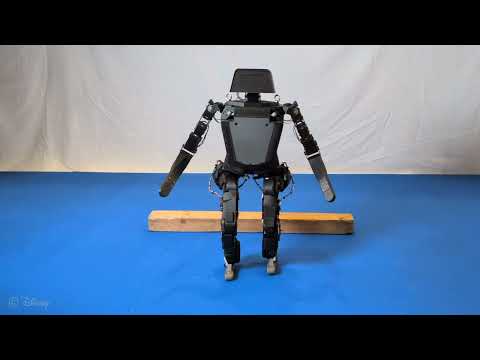
Despite these mishaps, roboticists are already working on solutionsUsing a reinforcement learning model, researchers at Disney Research in Zurich developed a new system that trained a test robot to fall in ways that minimize damage. This involved placing the robot in a virtual simulation where it fell thousands of times in every conceivable position. The AI was rewarded every time it landed in a way that minimized the resulting crash impact. Eventually, the robot internalized a new, safer protocol for hitting the ground. They put that to the test in the real world by intentionally tripping the robot with a stick to force falls from multiple angles. After a long day of tumbles, the robot showed no signs of noticeable damage and kept functioning as intended. The study’s results were published in an arXiv preprint server.
Solutions like these will almost certainly become more common in the coming years. If humanoid robots are ever to succeed in the physical world, they must know not only how to avoid falling, but also how to do so safely when a face-plant becomes inevitable. For that to happen, these machines, much like human toddlers learning to walk, will need ample space to fail, fall, and collect essential real-world data.
To put it another way: expect to see many more instances of robots falling down in public in the near future. Whether this clumsiness will ultimately lead to more capable machines remains to be seen. One thing is certain: it will almost certainly provide plenty of viral clips for the rest of us to chuckle at.