There is black, and then there is ultrablack. The shade defined as a black that reflects less than 0.5 percent of the light that hits it, is used on everything from telescopes to cameras. This uniquely dark color is not easy to produce and may appear less black when it is viewed at an angle.
To find a better way to reproduce this cool color, a team at Cornell University looked to nature. Specifically, a bird called the magnificent riflebird. The result is the darkest known fabric ever created and it is detailed in a study recently published in the journal Nature Communications.
A bird of a different color
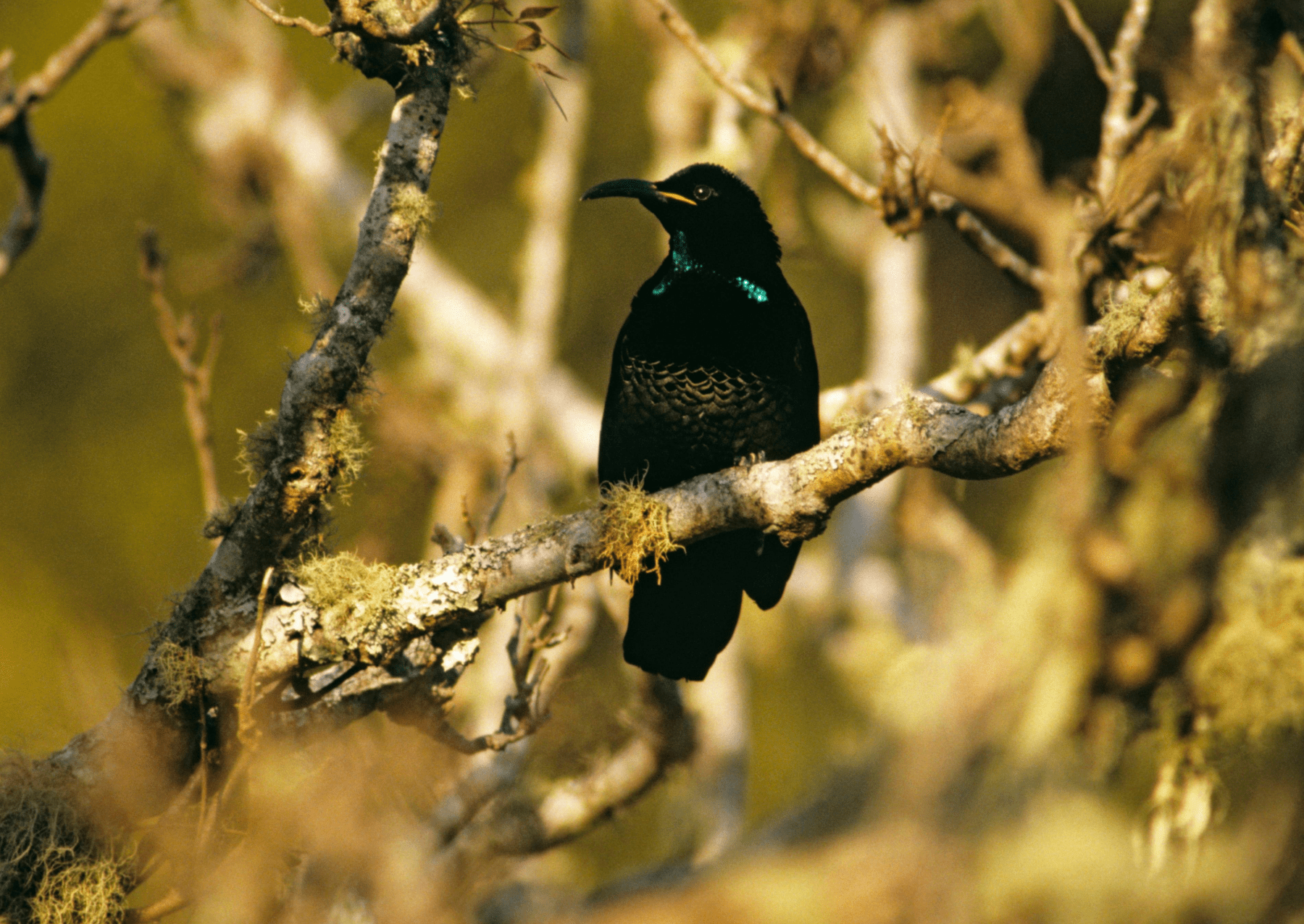
The magnificent riflebird is a large songbird and member of the bird-of-paradise family found in New Guinea and Australia. Male riflebirds are almost completely black, with a green and blue metallic sheen on their belly, throat, and crown feathers.
With the help of Mary M. Ferraro and Vanya Rohwer from the Cornell Lab of Ornithology, the team studied the riflebird’s black feathers. Their plumage comes from melanin pigment paired with tightly bunched filaments called barbules that deflect light inward. This combination of pigment barbules means that the feathers absorb nearly all the light that hits it, making the bird look extraordinarily black. However, the feathers are only ultra-back when it is viewed straight on. When looked at from an angle, the plumage appears shiny.
Dyeing and etching
Researchers in the university’s Responsive Apparel Design (RAD) Lab dyed a white merino wool knit fabric with polydopamine, a compound that can be used as a dark dye.
“Polydopamine is a synthetic melanin, and melanin is what these creatures have,” Dr. Larissa Shepherd, a study co-author and materials scientist, said in a statement. “And the riflebird has these really interesting hierarchical structures, the barbules, along with the melanin. So we wanted to combine those aspects in a textile.”
Simply coating the surface of the wool with polydopamine was not enough to create an ultrablack fabric. The polydopamine needed to completely penetrate the fibers of the fabric, so that every square inch became black. To do this, they etched the fabric in a plasma chamber to create spiky nanoscale growths called nanofibrils.
“The light basically bounces back and forth between the fibrils, instead of reflecting back out – that’s what creates the ultrablack effect,” added study co-author and doctoral student Hansadi Jayamaha.
The nanofibrils ultimately were a way to mimic how the riflebird’s ultrablack feathers trap light and absorb most of the light that hits them. By using this combination of polydopamine dye and the nanofibrils, the team created the darkest known fabric. In their new study, the team reports that the fabric has an average total reflectance of 0.13 percent, making it the darkest known fabric ever reported. It also remained ultrablack across a 120-degree angular span, so appears the same at up to a 60-degree angle either side or straight on.
“From a design perspective, I think it’s exciting because a lot of the ultrablack that exists isn’t really as wearable as ours,” Shepherd added “And it stays ultrablack even from wider angles.”
[ Related: Five people view a never-before-seen color called ‘olo’. ]
From the runway to solar panels
The fabric has several applications in both fashion design and the tech world. According to study co-author and doctoral student Kyuin Park, their ultrablack fabric could help solar panels convert and use absorbed light into thermal energy. “We could actually use the ultrablack fabric for thermo-regulating camouflage,” he said.
Additionally, fashion design major and recent graduate Zoe Alvarez created a black strapless dress inspired by the riflebird last fall. The ultrablack material was the centerpiece, with a splash of iridescent blue. Images of this dress were used to confirm ultrablack’s true “blackness.” When the image’s contrast, hue, vibrance, or brightness were all adjusted, the other colors changed, but the ultrablack remained the same.
The researchers have applied for patent protection and hope to create a company that dyes fabrics with their process. It can be used on natural materials, including cotton, wool, and even silk.