A supermassive black hole is reawakening inside a distant galaxy cluster—and after almost 100 million years of slumber, astronomers now say it’s making up for lost time. According to a study published today in Monthly Notices of the Royal Astronomical Society, J1007+3540 is erupting like a volcano and spewing plasma across interstellar space.
A black hole isn’t constantly devouring its unfortunate galactic neighbors. In fact, it can lay dormant for eons. But when one of these gargantuan entities finally reawakens, the resulting display isn’t only impressive—it illustrates the chaotic battle between its own cosmic forces and the pressures of the universe around it.
One of the most striking glimpses of such an event was recently captured by a team led by Shobha Kumari at India’s Midnapore City College. Supermassive black holes rarely emit magnetized, radio-emitting plasma, but according to Kumari, J1007+3540 is especially unique. After analyzing data collected by the Low Frequency Array (LOFAR) in the Netherlands and India’s Giant Meterwave Radio Telescope (uGMRT), researchers say there is undeniable evidence of multiple eruptions stretching deep into the universe’s past.
“It’s like watching a cosmic volcano erupt again after ages of calm—except this one is big enough to carve out structures stretching nearly a million light-years across space,” Kumari said in a statement.
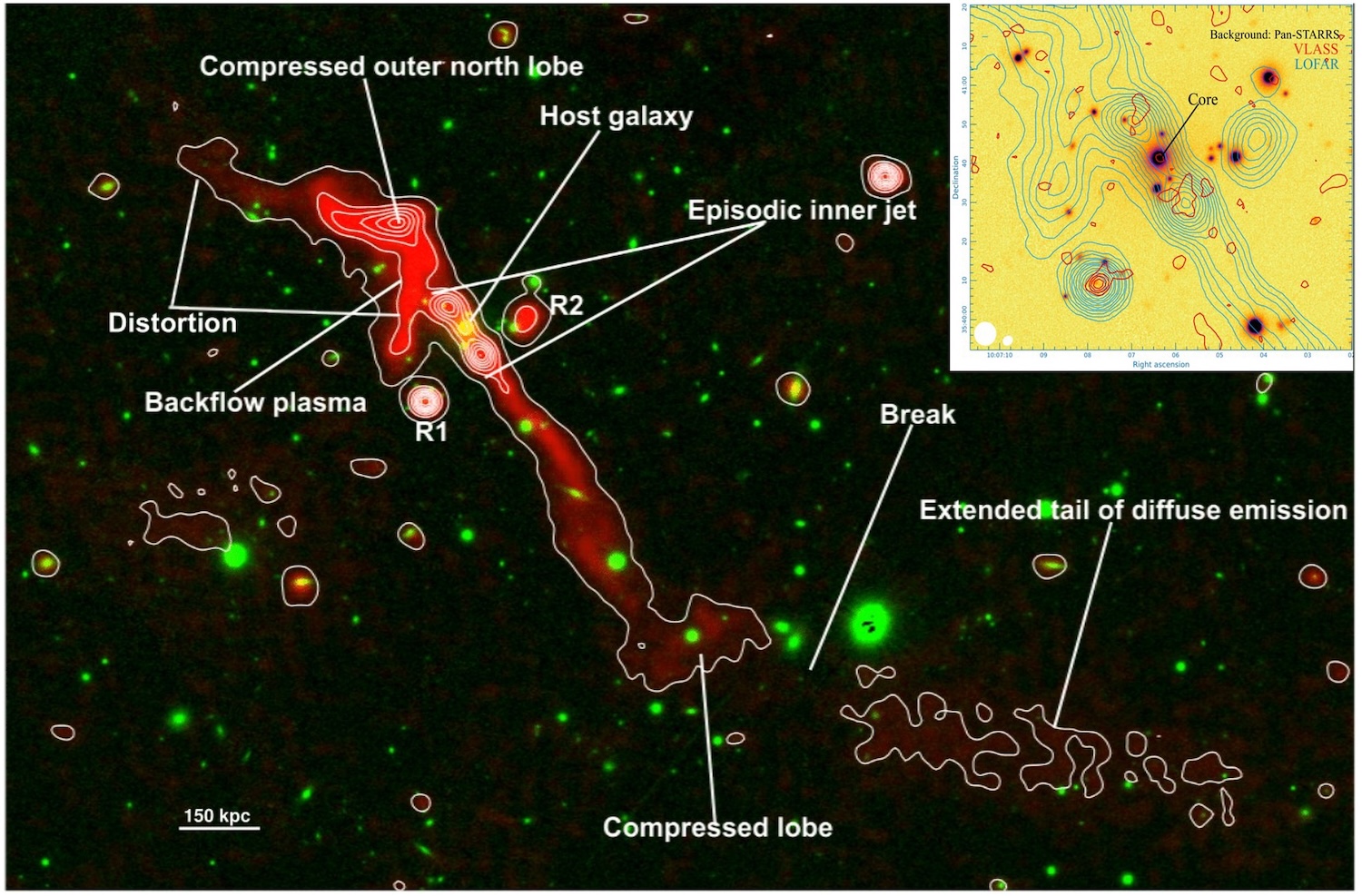
Radio imaging revealed a small, bright interior jet indicative of J1007+3540’s internal forces revving back up. But surrounding this illumination is an older layer of fading, distorted plasma from previous active eras.
“This dramatic layering of young jets inside older, exhausted lobes is the signature of an episodic [active galactic nucleus]—a galaxy whose central engine keeps turning on and off over cosmic timescales,” added Kumari.
The supermassive black hole’s forces are unfathomably strong, but the influences of the giant galaxy cluster around it can’t be ignored either. The surrounding plumes of incredibly hot gas exert their own pressure, in this case even higher than most other radio galaxies. These cosmic regions then mangle and distort J1007+3540’s plasma jets as they race outward. For example, LOFAR’s imaging depicts a compressed northern lobe that is curving to one side due to the galactic gas. Complimentary data from uGMRT reveals a very steep radio spectrum indicative of old, weakened plasma particles.
“J1007+3540 is one of the clearest and most spectacular examples of episodic AGN with jet-cluster interaction, where the surrounding hot gas bends, compresses, and distorts the jets,” added Surajit Paul, a study coauthor and astronomer at the Manipal Center for Natural Sciences in India.
Moving forward, Kumari, Paul, and their collaborators hope to employ higher-resolution equipment to peer into J1007+3540’s core. In doing so, researchers can better chart how the black hole’s reignited jets travel through the galaxy cluster, as well as how often such events actually occur.

2025 PopSci Outdoor Gift Guide