In 1976, workers excavating a tunnel for the Toronto subway system came across some very old bones. Using radiocarbon dating, researchers determined the partial cranium and fragments of antlers were roughly 12,000 years old.
As anyone who has lived in Toronto can tell you, waiting over a decamillenium for a train doesn’t feel uncommon. What was uncommon, at least to present day biologists, was that these fossils are the only known specimen from Torontoceros hypogaeus, a now extinct ungulate. Until recently, exactly how Torontoceros fit into evolutionary history was a mystery. But in October, researchers discovered that the ungulate was a relative of white-tailed deer, a finding that’s thanks to the wonders of DNA sequencing.
But how exactly do scientists extract DNA from thousands of years old bones? Well it takes a sterile lab, some drilling, and a good bit of luck.
DNA is everywhere, and that can be a problem
All of us live in a veritable soup of DNA. Every sneeze and cough leaves pieces of ourselves floating in the air and settling on the ground, but there’s also invisible bacteria and viruses all around us, all of which have their own DNA.
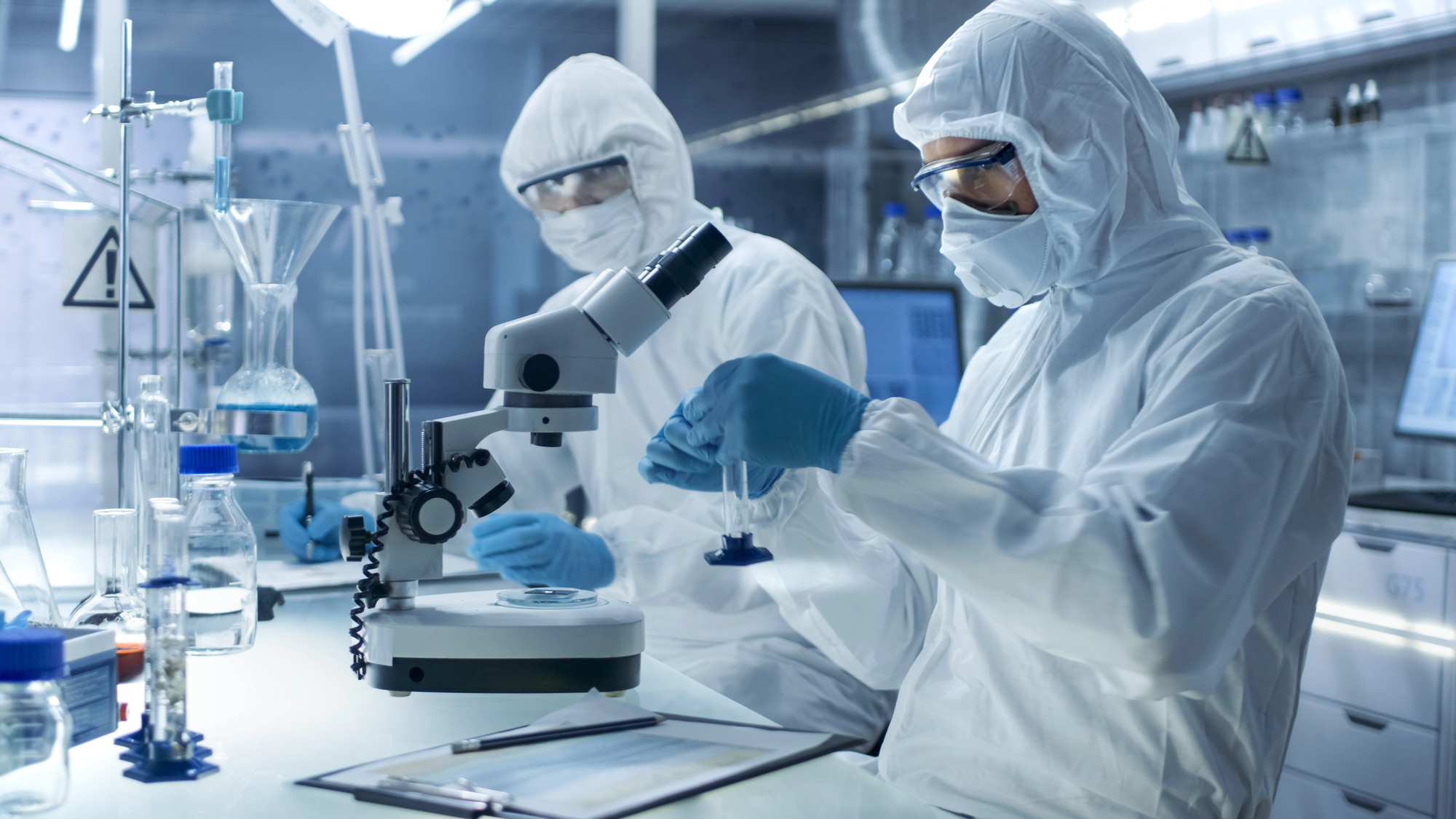
As Aaron Shafer, an associate professor at Trent University who led the sequencing research on Torontoceros explained, all that DNA floating around necessitates setting up a lab that can be zapped with ultraviolet lights to kill any possible contaminants. Researchers wearing sterile “bunny suit” coveralls and N95 masks then blast the fossils with UV once again, killing any viruses and bacteria clinging to the outside layer, before scraping away that layer as yet another sterility measure. A drill is then used to get into the interior of the bone, generating a fine powder.
“We grab the powder, and you’re hoping, fingers crossed, there are cells in that powder that contain fragments of DNA,” says Shafer.
Sometimes external DNA sources are useful
While outside sources of DNA may have been an issue for Shafer’s work on Torontoceros, for other researchers, those viruses and bacteria can be the entire point of their research. When Nicolas Rascovan, a biologist at Paris’ Pasteur Institute, examined teeth from the mouths of soldiers in Napoleon’s army, he didn’t care much about the soldiers. Instead, he wanted to find out what killed them as they retreated from Russia in 1812.
In a recent paper, he outlined how DNA sequencing of the teeth revealed the soldiers had died of enteric and relapsing fever. In that case, they opened the teeth up to access the dental pulp, the soft tissue that is supplied with blood. From that tissue, the team then extracted the DNA of the deadly bacteria the unfortunate soldiers carried.
How to isolate DNA
After the researchers get their DNA dust, it’s time to isolate it. There’s still lots of things that aren’t DNA, such as proteins, mixed into the powder. For Rascovan’s research, he used chemical reagents to dissolve the unwanted stuff, while leaving the DNA he was after. The solution was then mixed with a silicon powder, which has a positive charge, and mixed together with a centrifuge.
“A DNA strand has multiple negative charges,” he says. “That means that if you have something that has a positive charge, it can work as a magnet.” That magnetism helps the DNA strands stick to the silicon so the strands can then be read.
Digitizing DNA with fancy machines
Then, that physical DNA needs to be digitized so it can be analyzed. While there are several sequencers on the market, Rascovan says the most common is a machine from a company called Illumina.
These machines already have a library of artificially made DNA molecules, which are called adapters, that they can recognize. Those adapters, which are so tiny they’re measured in angstroms, or one-billionth of a meter, are then mixed in with the original sample. The adapters act as tags to make sure the Illumina machine can read the DNA strands the adapters bond to.
DNA is made up of billions of pairs of building blocks called nucleotides. The sequencer acts as a sort of camera, taking photos of the samples and using the adapters to identify the base pairs and compile them into a text file. The building blocks of life have now been converted into digital data that can be viewed, sorted, analyzed, and compared.
Related Ask Us Anything Stories
Ancient DNA can be tricky to work with
While DNA sequencing now has a wide array of uses, from criminal forensics to medical research, it can be particularly difficult to use for older samples, where DNA strands may be damaged or incomplete. Fortunately, DNA has changed relatively little over millions of years. For Shafer’s research, that meant that it’s possible to use chemical reactions to fill in or fix any missing or broken parts.
“If you were to look at the same region of DNA in a fresh sample and an ancient sample, there are certain base pairs that are deviating in the ancient base,” he says. “That’s your clue that something’s happened to them that isn’t natural.”
There’s just one problem: The sequencer analyzes all the DNA in the sample, whether it’s what the researchers are looking for or not. For Rascovan, that means there could be DNA from the soldiers and, for Shafer, DNA from any microbes that made their way into the Torontoceros fossil, along with any other sources of DNA that could have gotten into the samples during their time in the dirt.
Rascovan compared the procedure to taking a bunch of books, ripping out the pages, mixing them all up, and then trying to figure out the plot for one of them. The digitization of the strands means that each DNA fragment can be compared against an entire database, to determine not only which fragments are actually relevant, but how they stack up to known animals, bacteria, and viruses. For Rascovan, that meant comparing the strands to the DNA of disease-causing bacteria like typhus to determine what it was that caused Napoleon’s soldiers to die over 200 years ago. For Shafer, it gave him the ability to determine exactly where Torontoceros fit into the tree of life by comparing the ancient DNA to contemporary animals like deer and caribou.
Both Rascovan and Shafer acknowledge that along with some truly mind boggling technology, there is another key ingredient to their success: dumb luck. If too much time passes, or the samples are buried in conditions that are too warm or wet, the DNA they’re looking for could degrade to being useless. However, the tech is continually improving, and sequencing could be applied to more and more samples as time goes on.
“The techniques have gotten so much better,” says Shafer. “There’s a study that identified DNA from a million year-old fossils. If the DNA is there, if it’s well preserved, we’re able to grab it now.”
In Ask Us Anything, Popular Science answers your most outlandish, mind-burning questions, from the everyday things you’ve always wondered to the bizarre things you never thought to ask. Have something you’ve always wanted to know? Ask us.