Years ago I read an article asking, “Are you a night owl or a morning lark?” The piece explored the notion that some of us do our best thinking beyond midnight, while others prefer to rise and shine early and take in the day. At the time, I was staying up late into the night writing. However, these days I’m already at my desk by seven in the morning. So which of these tendencies suits me best?
It turns out that the answer to whether we’re night owls, early risers (aka “morning larks”), or even “intermediates” (not preferring mornings or evenings) is a lot more complex than we might realize.
How biology affects our preferred sleep cycles
“It’s not that there are ‘night owls’ and ‘early risers’ per se,” Dr. John Saito, a representative for the American Academy of Sleep Medicine, tells Popular Science. “It really depends more on where people are in their lives.”
For example, “when we’re young we tend to wake up early, and then when we get to our teenage years, we become night owls. Then in middle age, it kind of stabilizes until we get to our senior years, when we become morning larks again because our melatonin levels decrease,” which throws off our circadian rhythm—our 24-hour sleep/wake cycle.
But while research shows that our internal clocks shift significantly between ages 10 and 30, primarily driven by changes in hormones, our relative chronotype—our body’s natural inclination to snooze and wake at specific times—remains highly consistent. In other words, despite those biological changes at different life stages, we always remain (at least to some degree) either a morning person or a night owl.
Related ‘Ask Us Anything’ Stories
What determines your sleep chronotype?
A combination of genes, age, and environmental and lifestyle factors help determine each person’s individual chronotype. For example, someone who’s constantly exposed to morning light tends to wake earlier, while watching TV or doom-scrolling at night can set back your sleeping hours, causing you to become more of a late-night-type of person. People also tend to sleep more in fall in winter, because there’s typically less natural daylight.
People who live in cities are exposed to more artificial light, which can disrupt your circadian rhythm and suppress melatonin, the hormone that promotes sleep, as opposed to those living in rural areas. This can also cause you to stay up later.
Even how close you live to the equator can factor into whether you operate better “after hours” or in the a.m., since year-round sun exposure tends to make waking up in the morning easier.
How genetics affects your sleep preferences
Then there’s genetics, which plays a big role in determining a person’s chronotype. According to one study, 351 genetic factors influence whether a person prefers mornings or evenings.
There may be an evolutionary advantage to different people having different sleep patterns. Some theories suggest that having different sleep chronotypes was beneficial for early human groups, ensuring someone was awake to keep watch at all hours.
These “built-in night guards,” says Saito, may also be hereditary. This means that if your parents or grandparents “burnt the midnight oil,” or regularly stayed up well past midnight, there’s a good chance that you do, too.
Breaking down your sleep chronotypes even more
Clinical psychologist and sleep specialist Dr. Michael Breus believes that chronotypes fall on a larger spectrum. “While the traditional categories are ‘morning lark’ and ‘night owl,’” says Saito. “Breus then breaks these broad categories down further.”
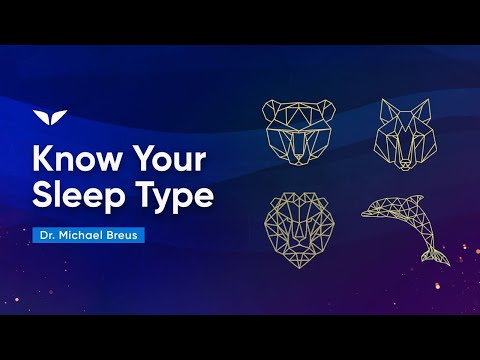
He’s determined four distinct chronotypes (which Breus calls “sleep animals”) intended to help optimize each person’s schedule in terms of sleep and energy.
4 Different Sleep Types | Dr. Michael Breus
Dr. Michael Breus believes there are four different kinds of sleep chronotypes. Video: 4 Different Sleep Types | Dr. Michael Breus / Mindvalley
‘Bears,’ a type of ‘intermediate’ that Breus says account for between 50 and 55 percent of the population, tend to rise and sleep according to the solar cycles. Late-night ‘wolves’ (15 to 30 percent) are most productive in the evening.
Then there are ‘lions’ (15 percent), those early risers who at 9 p.m. are begging for sleep. Light-sleeping ‘dolphins’ (10-15 percent) get their moniker from always being on high-alert. Things like light, noise, and changes in temperature easily disturb them, and they often struggle with insomnia.
Once you determine your chronotype by taking Breus’s online quiz, Breus says you can then determine the best time for working on big projects, eating, and getting exercise.
For instance, a bear chronotype should save early mornings for practical work, while late evenings are best for creative brainstorming. Start the day off with a protein-heavy breakfast, and wait at least 90 minutes after waking before having any caffeine. This allows your body to come alive on its own. Then when you feel time for an alert-boost, that coffee or tea can be ready and waiting.
Saito agrees that whether you prefer the morning or night isn’t always so cut and dry. For example, “Being an insomniac doesn’t necessarily mean you’re a night owl,” he says. “You just sleep in very fragmented ways.”
Is one sleeping pattern better than the other?
While studies show that early risers are typically in better health physically and mentally, night owls and intermediates are both associated with sharper memories. However, those staying up until the crack of dawn often have an increased risk for obesity, depression, and even Type 2 diabetes.
Still, the most critical factor, says Saito, is to “align your schedule with your natural, genetic rhythm and avoid insufficient sleep,” which in itself can lead to medical conditions like memory loss, weakened immune systems, and heart disease.
Most schedules aren’t so easy to change, whether they involve work, family, or daily commitments. But knowing what times of day you operate best can go a long way towards maximizing productivity—and warding off long-term health issues.
Sleep consistency is key, says Saito, whether you wake up early or stay up late. Try going to bed at the same time each night, and plan activities at a time when you’re most alert.
For example, if mornings are when you’re at your peak, suggest a walk with a friend or an early coffee date rather than dinner. The same goes for work. If your job is flexible, try tackling the toughest projects when you’ve got the most energy.
“It’s all about your physiology and how your body works,” says Saito. There’s no one-size fits all approach, but attuning to your chronotype as much as possible—according to where you are in life—can go a long way towards reducing stress and preventing burnout.
“Ultimately, the best thing to do would be to match your physiology with your social structure,” says Saito. So if you’re a night owl and you also happen to be a late-night radio DJ, you’ve probably found your perfect job.
In Ask Us Anything, Popular Science answers your most outlandish, mind-burning questions, from the everyday things you’ve always wondered to the bizarre things you never thought to ask. Have something you’ve always wanted to know? Ask us.

2025 PopSci Best of What’s New