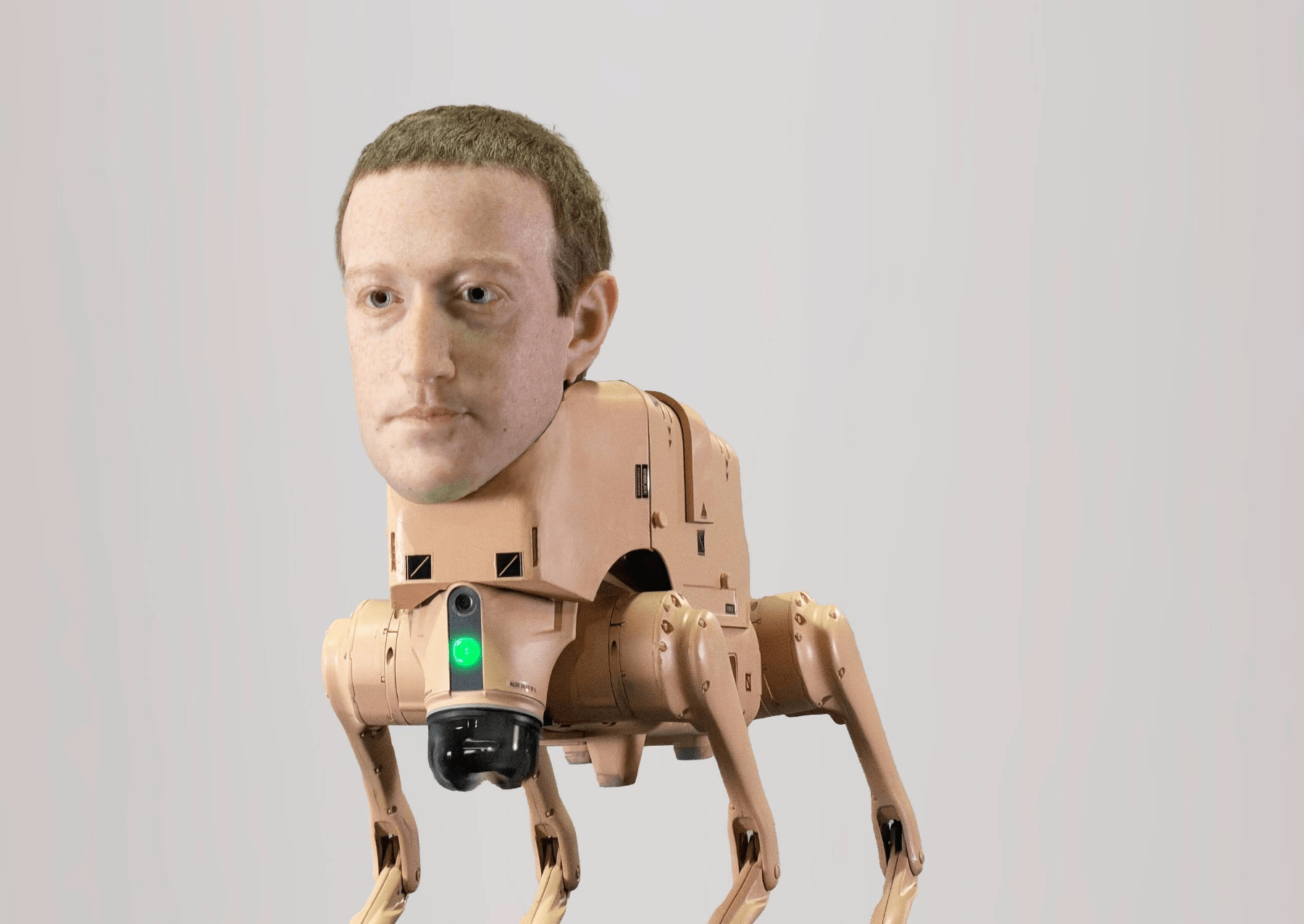
Robot dogs are already a bit creepy. But slap on a hyper-realistic image of a tech billionaire’s face and have them literally crap out a piece of AI-generated art and you’re left with something that would make Black Mirror producers shudder.
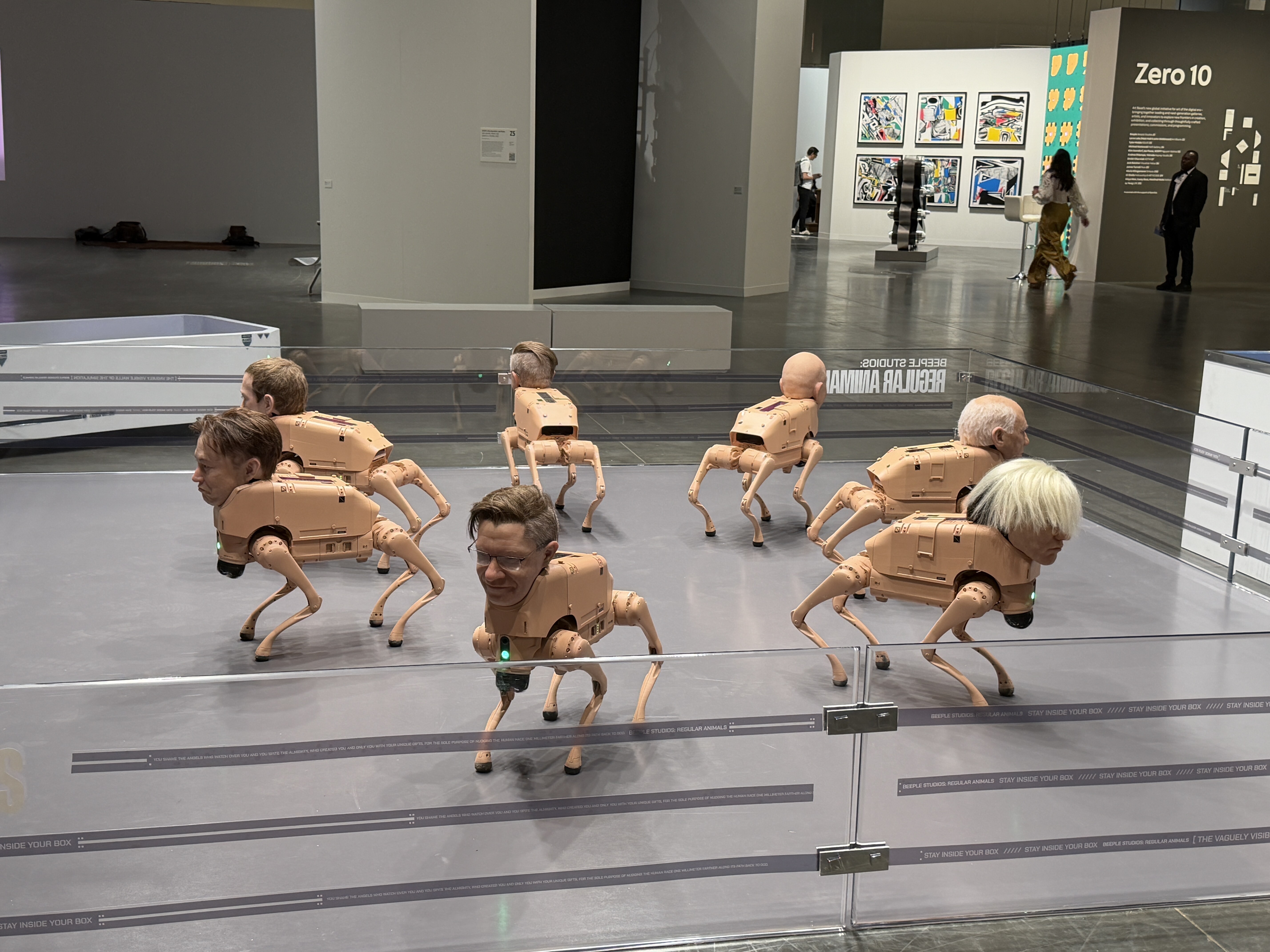
That’s exactly what’s on display at Art Basel Miami, one of the world’s most prodigious art fairs. In Regular Animals, the event space is crowded with six flesh-toned robotic dogs, each bearing a detached, photorealistic head of Mark Zuckerberg, Elon Musk, Andy Warhol, Pablo Picasso, or the installation’s creator, digital artist Beeple. Every few moments, the dogs stop, lean back on their hind legs, and pinch off a Polaroid-like print from their rear ends. A small LED screen on each dog’s back flashes “POOP MODE” while this performance art occurs.
“What if the act of looking at art were no longer a one-way encounter, but part of a feedback loop in which the artwork observes, learns, and remembers us in return?” Beeple said in an artist statement accompanying the installation.
Each of the human-dog hybrids has cameras located around its head, continuously capturing photos of the surrounding environment. That data is used (presumably with the help of an AI image generator) to create the prints that the dogs “poop” out. Much like AI-generated slop flooding the internet, these digital creations are voluminous. The New York Post reports that the robots will collectively produce 1,028 prints over the course of the exhibit, 256 of which are verifiable NFTs (non-fungible tokens) that can be listed on cryptocurrency marketplaces. Each image is labeled “Excrement Sample.” Unlike an actual dog’s daily sample, these will likely rack up monetary value over time.
But while the end products are appropriately crappy, no two photos are exactly alike. The piles of prints each carry an aesthetic that reflects the personality of the human head attached to the dog. The Picasso images appear geometric, while those pushed out of the Zuckerberg dog’s rectum look like a clip from a low-budget Matrix knockoff. More examples of the prints, which Beeple refers to as “memories,” are viewable on the installation website.
‘Beyond disturbing’
Each artist or billionaire inspired robot dog has its own “temperament.” For example, Elon Musk’s is described as a “cognitive blueprint,” while Picasso’s is “proto-cubism.” (Beeple’s dog, for what it’s worth, has a temperament of “dystopic futurism”). Each also has its own speed setting—slow, medium, or fast. Maybe unsurprisingly, the tech billionaires all fall into the fast category.
This dystopian fever dream is the brain-child of Mike Winkelmann, (aka Beeple) an artist best known for his oddball NFT images created at the onset of the COVID-19 pandemic. He gained mainstream attention in 2021after a collection of 5,000 of his images sold for $69.3 million at Christie’s in its first-ever NFT auction.
Beyond fueling nightmares, Beeple says the bigger point of this robodog project is to draw attention to how more and more of the observable world consists of benign design, created to fulfill the vision of a select few techno-billionaires. That, he says, contrasts with past eras, when artists played a greater role in shaping reality.
“It used to be that we saw the world interpreted through the eyes of artists, but now Mark Zuckerberg and Elon, in particular, control a huge amount of how we see the world,” Beeple told The New York Post. “We see the world through their eyes because they control these very powerful algorithms that decide what we see.”
Reactions to the installation, at least so far, seem notably less highbrow. Commentators online have described the event as “terrifying,” “absurd,” and “beyond disturbing.”
One Instagram user, conversely, said they “want one” referring to the dog-human hybrid. Apparently, they aren’t alone. The Post notes that all of the robots on display have already sold, for $100,000 each. While it’s unclear who the dogs’ new owners are, plenty of deep-pocketed Silicon Valley titans and artists attended Art Basel.