When 12-year-old Matteo Mucchetti mapped out an amusement-style attraction that he wanted to create in his family’s basement and then showed it to his older brother Nico, the high-school sophomore was immediately sold. “This is amazing,” said Nico. “Let’s make it!”
Matteo had sketched on paper a top-down view of the multi-room space in Bear, Delaware, where they live. Not only did it chart the overall path of what would become a Disney-style dark ride, but it also highlighted the placement of the ride’s individual story “scenes.” Nico, a high school sophomore, then helped bring Matteo’s vision to life.
Designing an attraction inspired by Disney’s Big Hero 6
It wasn’t easy, but the brothers worked together tirelessly over seven months. While Matteo took on the role of “artistic director,” coming up with the overall vision and then helping to plan, build, design, and paint the attraction, Nico played the role of tech guy and animator. He used the Arduino IDE, an open source electronics platform for creating interactive projects, to write most of the attraction’s coding from scratch. This included codes for controlling the ride vehicle as well as to trigger moments like the opening-and-closing of two specially built doors placed along its tracks.
They named their attraction “Big Hero 7,” after the 2014 Disney animated movie, Big Hero 6, which served as the ride’s inspiration. In the latter a young robotics prodigy and his healthcare robot, Baymax, form a superhero team to combat crime. “Big Hero 7 is a continuation of Big Hero 6,” Matteo tells Popular Science. “In our story, you are becoming the team’s seventh member.”
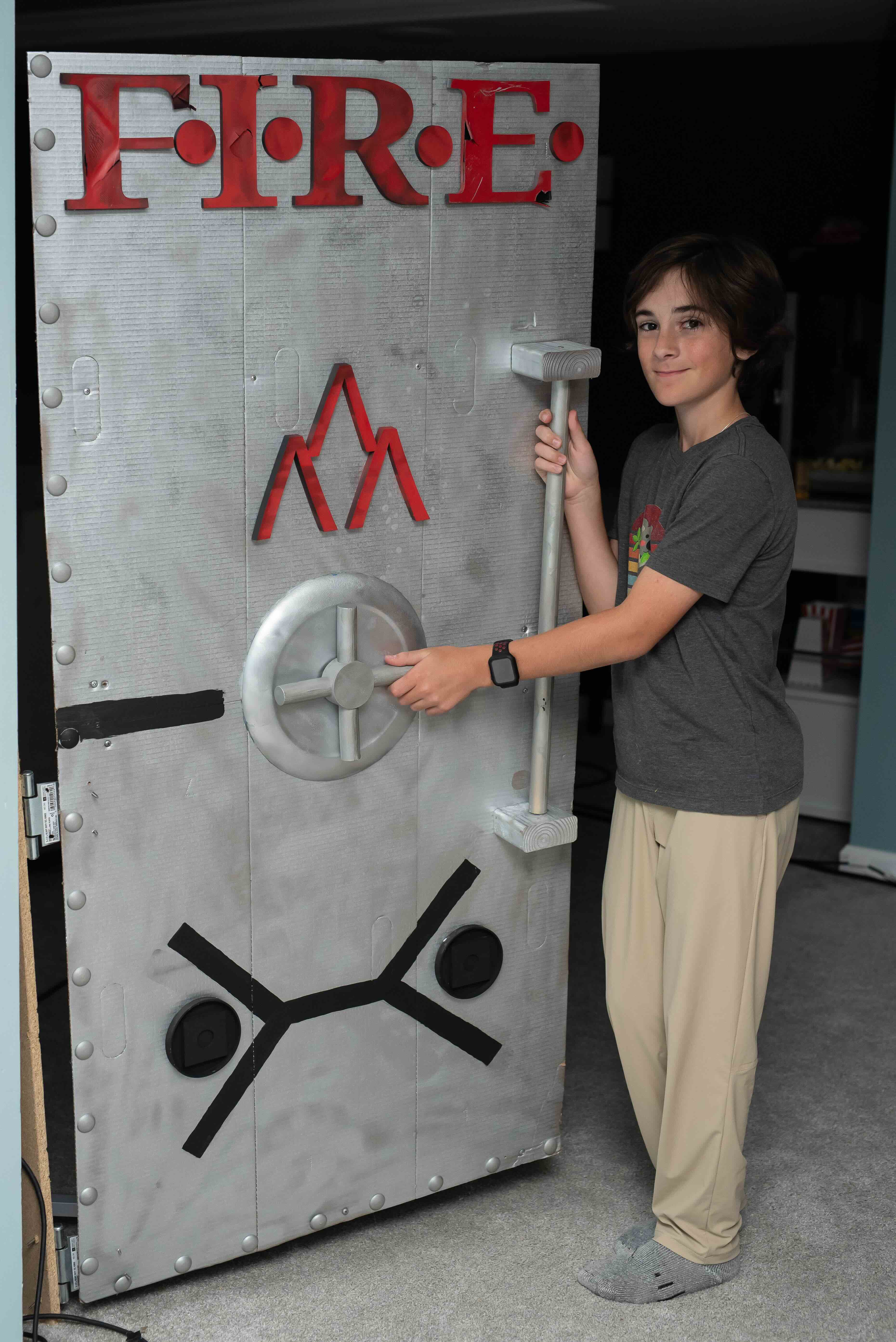
Inside the brother’s “Big Hero 7” ride
Nico and Matteo then opened up their ride to friends and family in the fall of 2025.
The attraction began in a small preshow area featuring portraits of Big Hero 6 characters, as well as tools that appeared in the film, adorning the walls. In a nearby corner sat an animatronic Baymax that Matteo and Nico had crafted on their own 3D printer. The robot served as the ride’s narrator and let people in on its theme, which was to stop a factory of evil robots known as F.I.R.E. (flamethrowing and intelligent robot entrepreneurs) from destroying San Fransokyo, a futuristic mashup of San Francisco and Tokyo.
From there, riders boarded an autonomous ride vehicle, meaning it operates without human intervention. The boys had built it to resemble a helmet worn by the movie’s main character, Hiro Hamada. Matteo even took a hammer to its exterior, which was made of wood, to make it look distressed. It could fit one rider at a time.
“Maybe two,” says Matteo, “but we didn’t want to risk it.”
From the pre-show area, the vehicle traveled through a narrow passage between an open door and a wall, and then entered a “restricted area,” which was basically a darkened space with flashing lights and ominous music, divided by a curtain. “This gave the ride something to circle around, and increased the length of the track itself,” says Nico. It then continued through an automated door and past the Mucchetti’s small home theater room where surveillance footage of robots displayed on the screen, and a table with some ride-related thematic elements like a small robot head and a voltage generator.
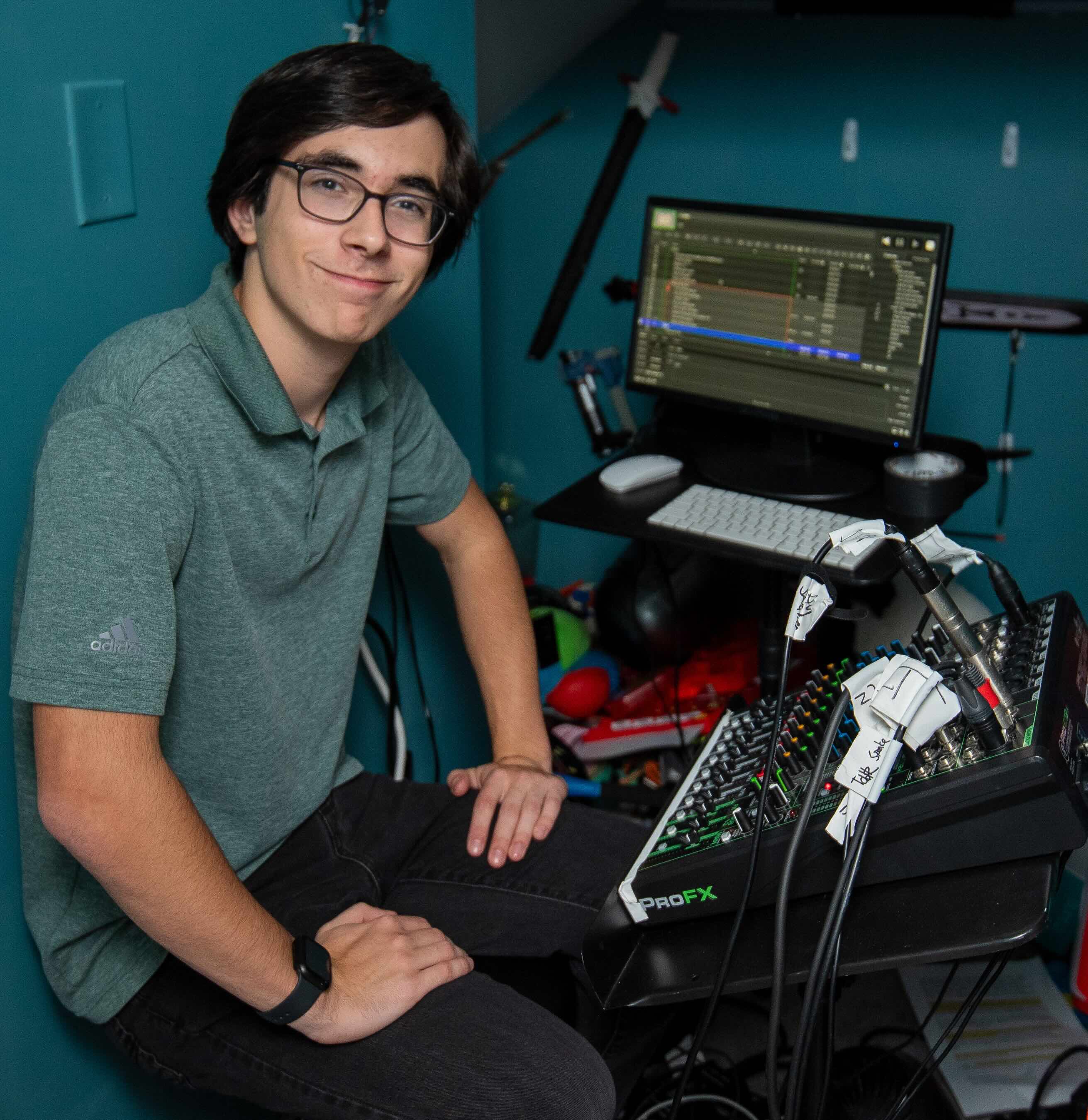
“Finally,” says Nico, “riders thought they were going through a small doorway, but then it closed off in front of them. The vehicle then turned and entered the final room instead.”
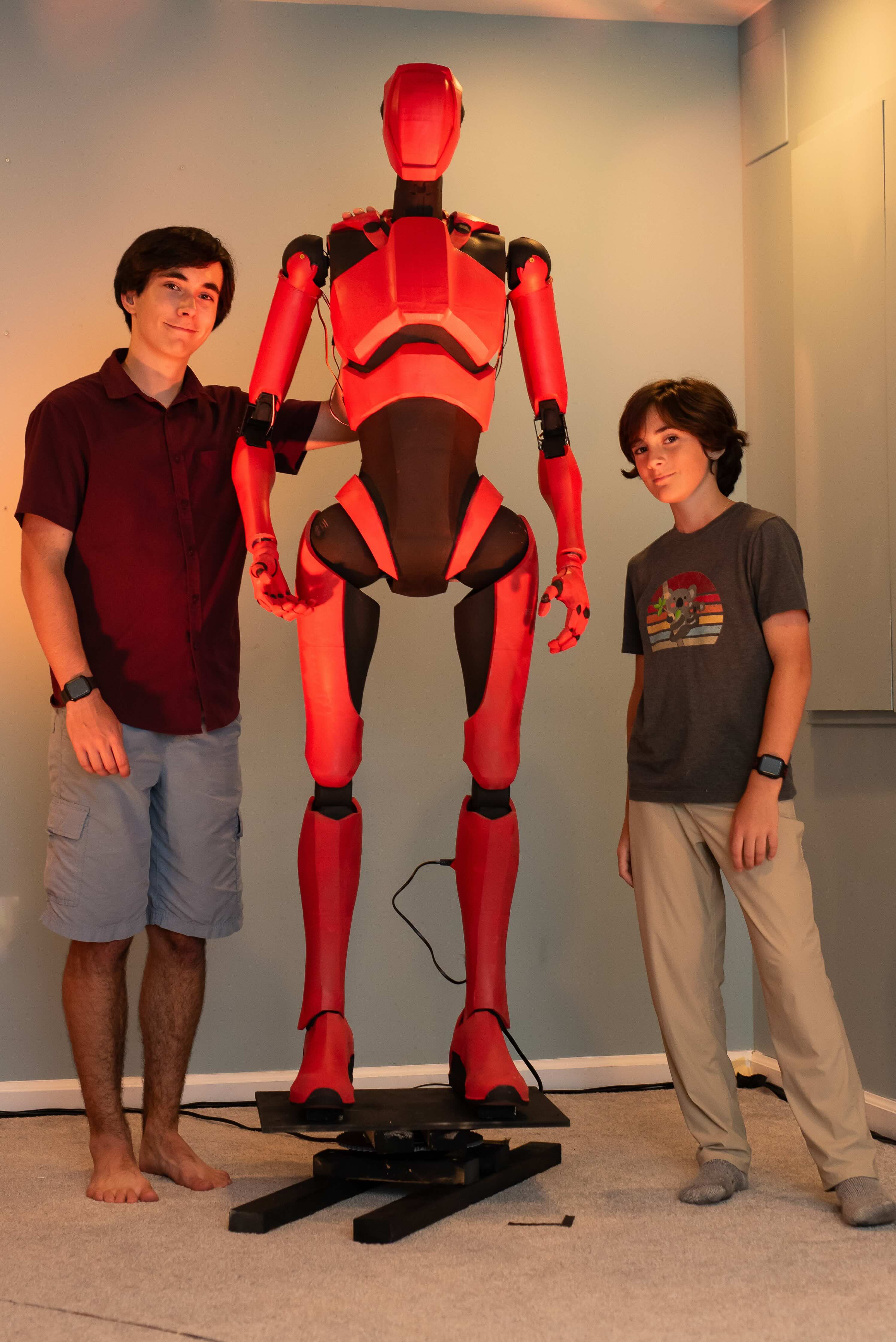
This is where riders encountered Baxter, a towering six-and-half-foot-tall animatronic robot that the boys made and named after Tony Baxter, a famous Disney imagineer. At one point the robot appears to throw a fireball over the ride vehicle.
“I especially like this part,” says Matteo, “because the sound travels through the room.” The attraction then concluded in the same space where it started, lasting five-to-six minutes in total.
Building the ride’s autonomous car vehicle
Although the brothers initially wanted the ride vehicle to navigate itself without a track, they decided to switch to a line-following system (basically, a marked path that an autonomous vehicle can follow) for ease and affordability. They then made a track out of reflective metallic tape and laid it out in a shape resembling a distorted infinity symbol.
Nico then equipped the ride vehicle with a Raspberry Pi Pico—a type of microcontroller used for real-time tasks—to control its two motors and placed a line sensor at its front. “The sensor reads the small reflective line on the ground,” he says, using infrared light, “and that tells the vehicle where to go based on a controlled algorithm.”
The brothers also placed additional strips of reflective tape perpendicular to the line itself and equipped them with transmitters. When the sensor activated a transmitter, it would send a signal to what they called the “booth” (essentially a central computer area) that would trigger one of the attraction’s lights or sounds.
Making Baxter, the ride’s big bad
To create Baxter they employed Unity, a game design tool used for creating 2D and 3D games. “He has a wood skeleton, and then all of the exterior bits are 3D printed and have been painted and distressed as necessary,” says Nico.
Each of Baxter’s 10 moving joints are powered by their own servomotor—a specialized motor that allows its user to precisely control how much something moves—including his head, arms, and shoulder joints. The boys then used Bottango, a user-friendly animatoric animation software, to program his movements. “It took us nearly three months to create him.”
“I would say we did our best to make the ride entirely understandable if you have no Big Hero 6 experience,” says Nico. Still, those who’d seen the movie may have noticed little tributes to it, including Baymax and the appearance of San Fransokyo. Matteo also hid several “Easter eggs” along the ride, including a miniature Baxter robot on the top of San Fransokyo’s Golden Gate Bridge.
Operating the ride
After they finished building the ride in the fall of 2025, the boys kept it up for two more months, from the beginning of October until after Christmas (although some “souvenirs” such as Baxter, remain). They then reopened the space for their parents’ use. About 100 people rode it in total, and the brothers used the attraction as a food drive, collecting enough donations to fill up their family’s SUV.
“When people finished the ride I think they were in shock,” says Matteo. “They were just kind of like, ‘Wow, this is incredible.’”
Nico and Matteo say they’d love to work together again on another project, if they can find the time. “I think it would be a lot better because we have a lot more experience with this type of thing now,” says Nico. “But I can also see Mom eyeing me and wondering if she’s ever going to have her basement back.”
In The Workshop, Popular Science highlights the ingenious, delightful, and often surprising projects people build in their spare time. If you or someone you know is working on a hobbyist project that fits the bill, we’d love to hear about it—fill out this form to tell us more.
Related ‘The Workshop’ Stories
2025 PopSci Best of What’s New