Engineers in Switzerland recently created a detachable, spider-like robot hand capable of grabbing multiple objects and using its fingers to crawl. The unsettling device, reminiscent of a threatening video game creature, can separate itself from a mounted robot arm, tip-toe (or really, tip-finger) its way toward small objects, pick them up, and carry them on its back.
The symmetrical design and flexible fingers mean that the robot can transport objects on either side of its body. For humans, that would look like holding a ball in your palm while simultaneously grasping a piece of fruit on the back of your hand. But the robot hand’s designers say this bizarre form factor is more than just the product of a creepy fever dream: it’s an example of a design that’s more efficient than the human hand, unburdened by natural selection’s pesky constraints.
The researchers from Swiss Federal Institute of Technology detailed their findings this week in Nature Communications at the Swiss Federal Institute of Technology Lausanne.
“Evolution is a slow process, whose path is influenced by a variety of developmental and environmental constraints,” the team writes. “It does not explore all that could be possible.”
Restored symmetry
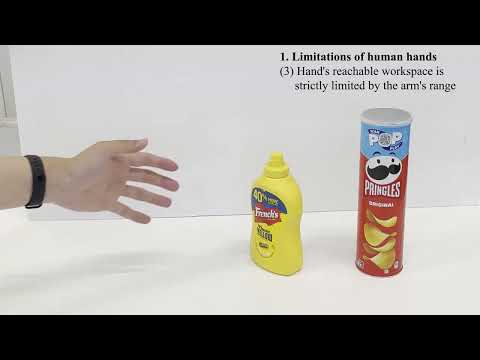
The accompanying video shows the robot hand, still attached to its arm mount, picking up a mustard bottle before flipping over and grabbing a can of potato chips using the opposite side of its palm. In another example, it easily lifts a tomato with two fingers while holding a second object between fingers on its far side. The hand then detaches from the arm and scurries forward towards a bannana, flips it upward and secures it on its backside using a single finger.
Mixing human dexterity with an Octopus’ multimodal movement
According to the team, the robot hand’s fully symmetrical design allows its five fingers and dual thumbs to move with as much flexibility backward as they do forward. That adaptability means it can simultaneously hold up to three different objects, with a combined weight of around five pounds. All that added range of motion gives it the ability to replicate 33 different types of human grasping motions.
”Despite its remarkable capabilities, the human hand’s asymmetrical shape and single opposable thumb, as well as inherent attachment to the human arm, limit its functionality,” the researchers write.
Though the design is meant to address the biological limitations of the human hand, it also takes some inspiration from nonhuman animals. Specifically, the researchers point to octopuses and certain insects that use their finger-like limbs to move around and manipulate objects in their environments at the same time. Octopuses, in particular, are capable of opening jars faster than some humans.
There’s also precedent for this kind of dexterity in robotics. Spot, Boston Dynamics’ dog-like quadruped developed, uses its four limbs to walk, but it can also use an additional claw-like appendage to pick up objects and open doors.
Related Robotics Stories
More fingers aren’t always better
To build their robot hand, the engineers began by creating a digital library of human hand grasp postures. They then used a computer algorithm to determine the optimal level of movement and number of fingers to solve both for grabbing and moving.
Interestingly, more fingers aren’t always better. Each additional finger adds mass, increasing the chances that fingers will collide, and making overall movement more clumsy. Researchers found that increasing the finger count from three to five improved the hand’s crawling efficiency, but adding more beyond that resulted in diminishing returns.
Related: [Robot hands are becoming more human]
This approach to robot design runs counter to the growing trend in humanoid robots. Major tech companies in the emerging robotics space—including Figure and Tesla—are investing heavily to create hands that instinctively mimic human design. The underlying idea is that designing robots to function like humans allows them to perform tasks humans already do, without needing any additional specialized equipment.
The hand crawler takes a different approach. While it’s not yet clear whether this design will be implemented in other robots, one can imagine a humanoid using a hand crawler to perform factory work, then deploying the removable hand to reach distant objects or rummage through narrow, cluttered spaces.
Of course, if all else fails it could also always be used as an incredibly over-engineered prop on a horror film set.

2025 PopSci Best of What’s New