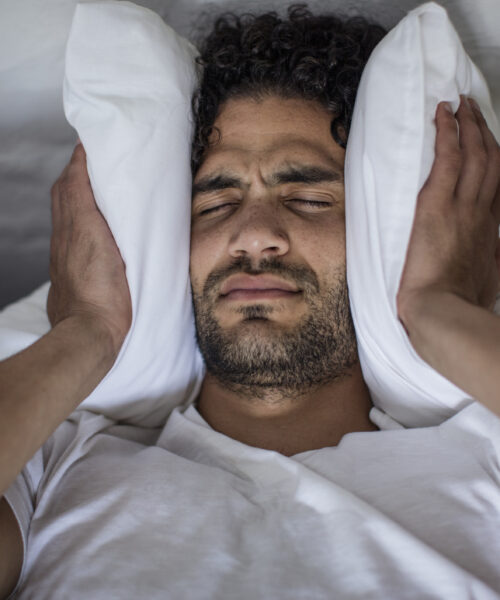
It happens all at once—your heartbeat becomes a jackhammer, your body closes in on you like a corset. The dizziness, shortness of breath, and catastrophic thoughts are so formidable, you think you might be dying, even though you’re in perfect health.
Up to one third of people experience at least one panic attack in their lifetimes. At its core, a panic attack is an overreaction of the body’s normal response to perceived danger. Sometimes the cause is obvious—like a real threat or a big change—but other times, it seems to appear out of the blue.
“This is our fight-flight-freeze response,” clinical psychologist Dr. Reid Wilson, author of Don’t Panic: Taking Control of Anxiety Attacks, tells Popular Science. “Your body and mind are trying to protect you as a reaction to [a] perceived threat.”
What happens in your body when you panic
When we perceive an external threat through our five senses, the senses’ ambassador in the brain—the thalamus—fires off a message. This message is sent deep inside the brain to the amygdala, a tiny bundle of nerves that serves as our chief arbiter of curiosity and avoidance. The amygdala interprets that message and sends a distress signal to the hypothalamus, the command center for involuntary bodily functions, like breathing. The hypothalamus then sends a chemical S.O.S. to the adrenals, prompting them to dump cortisol and adrenaline into the bloodstream.

“This continues as a cascade of changes throughout the body,” Wilson says. We’ve switched to an automatic part of ourselves. “The conscious mind is not in control.” If a lion is charging you and milliseconds are the difference between life and death, there’s no time to weigh options. Your body makes decisions for you.
Your pupils dilate. Your breathing and heart rate increase. Your mind hyperfocuses. Your blood re-routes to de-prioritize less essential areas like fingers and toes.
For a long time, this outside-trigger fear chain was thought to be applicable to all panic, with the amygdala seen as the engine of all fear. But recently, researchers like clinical neuropsychologist Dr. Justin Feinstein, Director of the Float Research Collective in Maui, have found that the amygdala’s behavior is actually context-dependent. According to Feinstein, fear triggered by bodily sensations, like suffocation, is another cause of panic attacks. This could account for panic attacks that seem to start “out of the blue.”
How holding your breath can trigger panic
Have you ever had a busy day and suddenly notice that you haven’t taken a deep breath in awhile? In some instances, the amygdala is doing the opposite of kindling fear—instead, trying to quell fear, and in doing so, inhibits breathing.
This phenomenon is called amygdala-driven apnea, where people hold their breath without even realizing it, provoking an avalanche of panic symptoms as their bodies try to protect them from suffocation. “The amygdala could cause your breathing to completely stop and you will have no awareness that it has stopped,” Feinstein tells Popular Science.
This reaction is part of the freeze response. Evolution gave humans the ability to unknowingly hold our breath when we need to focus on survival. Think about it: If you’re an ancient primate about to get eaten by a predator and you’re trying to hide by playing dead, what would give you away immediately? That pesky breathing thing.
But what happens when you’re holding your breath in multiple mini-crises throughout the day, like when you’re late for a meeting, then stuck in traffic, then you open your email and there are 80 urgent messages that need your attention? While none of these alone are inducing an attack, these bouts of apnea add up.
“Different types of triggers are setting [a person’s] amygdala off throughout the day, and at the same time, causing their breathing to stop, their CO₂ to go up, and then their chemoreceptive system to be all out of balance,” Feinstein says. “The chemoreceptive system is a key part of panic attacks.”
Chemoreceptors are sensory cells that detect changes in the composition of your blood and send information to your brain to keep your cardiovascular and respiratory systems balanced. Think of them as tiny pH meters. An uptick in CO₂ from inadvertently holding your breath throughout the day could be enough to prompt the chemoreceptors to send an alarm to the brain, inducing a panic attack.
How to deal with panic
While it may be a good idea to drink less caffeine, exercise, and sleep at night, most of the recommended strategies for panic aren’t related to lifestyle, but to retraining your thoughts.
Mindfulness can make a big difference. Feinstein recommends paying more attention to your breathing. “One of the most important things we could all do is learn how to be better, conscious breathers. We breathe so unconsciously throughout the day and night, having no awareness at all whether our breathing has stopped. You don’t want CO₂ levels too high, you don’t want CO₂ levels too low. Both could create big problems, and both could create anxiety. You want the CO₂ to be right in the middle of where the chemoreceptors are calibrated.”
Related Ask Us Anything Stories
Above all, don’t change your life to avoid panic attacks. The greatest danger for people who experience regular panic is agoraphobia, experts say. Panic disorder with agoraphobia is a condition that people can actually unwittingly give themselves if they try to manage their panic by avoiding situations they think might trigger them. It’s easy to blame your circumstances when you feel panic, but this can cause people to shrink their world.
Both Feinstein and Wilson have seen this countless times. “Your brain is trying to attribute these operations of fear to things in the environment. And this is where panic disorder actually becomes extremely, extremely debilitating,” says Feinstein. If you have a panic attack while driving to a friend’s house, that doesn’t necessarily mean you shouldn’t see that friend anymore.
That’s why what you tell yourself in moments of stress is another major piece of the puzzle. Anger at yourself for feeling anxious only makes it worse. The goal here isn’t to “prevent all future attacks,” but instead to grow your confidence in stressful situations.
“Acceptance of physical sensations during panicky times is a therapeutic intervention,” Wilson says. “Develop a willingness to experience the symptoms instead of avoiding them.” This may sound simplistic, but there’s science behind this strategy.
“We want to train your neurology,” he says. “The tendency to resist symptoms of panic is, of course, automatic. But we add a new conscious message. Your brain needs to experience you purposely and voluntarily greeting and accepting the symptoms.” You can do this by doing the things that make you nervous, while simultaneously swapping out the self-talk happening in your mind.
“The stance of ‘I can’t handle this’ encourages anxiety and avoidance,” Wilson says. “Arriving at a stance of ‘I don’t like it, but I can handle it’ is your best disposition.”
In Ask Us Anything, Popular Science answers your most outlandish, mind-burning questions, from the everyday things you’ve always wondered to the bizarre things you never thought to ask. Have something you’ve always wanted to know? Ask us.