Astronomers have spotted an asteroid the size of nearly eight football fields, with the help of the largest digital camera in the world and a new space observatory. Asteroid 2025 MN45 measures about a half mile in diameter and is the fastest spinning asteroid of its size ever recorded. The team from the National Science Foundation (NSF) and United States Department of Energy (DOE) presented their findings in The Astrophysical Journal Letters.
Spin speed matters
To spot this asteroid, the team used the cutting-edge Vera C. Rubin Observatory. Located on a mountaintop in Chile, the observatory will repeatedly scan the sky for 10 years using the 3,200 megapixel LSST Camera to create an ultra-wide, ultra-high-definition time-lapse record of our universe. With this camera, Rubin can take an image every 40 seconds.
“NSF–DOE Rubin Observatory will find things that no one even knew to look for,” Luca Rizzi, an NSF program director for research infrastructure, said in a statement. “When Rubin’s Legacy Survey of Space and Time begins, this huge spinning asteroid will be joined by an avalanche of new information about our Universe, captured nightly.”
While the observatory is expected to be fully up and running this year, preliminary observations taken in June 2025 revealed 1,900 asteroids never seen before.
As these asteroids orbit the sun, they rotate at a wide range of speeds. For scientists, these spin rates offer clues about how they formed billions of years ago and can tell us more about their composition. An asteroid spinning quickly—like 2025 MN45—may have sped up because of a past collision with another asteroid. This means it could be a fragment of an originally larger object.
Fast rotation also requires a space rock to have enough internal strength to avoid fragmentation—when it flies apart into smaller pieces. Most asteroids are considered “rubble piles,” made of many smaller pieces of rock that are held together by gravity. Without this more solid core, they have speed limits as to how fast they can spin without coming apart.
Objects in the main asteroid belt—located between Mars and Jupiter—must rotate completely in 2.2 hours to avoid fragmentation. Anything spinning faster must be structurally strong to remain intact. If an asteroid is spinning above this limit and is fairly large, then it must be made of stronger cosmic material.
Related Stories
Enter the super rotators
The new study uses data collected over the course of about 10 hours across seven nights during Rubin Observatory’s early commissioning phase in April and May 2025. The astronomers found 76 asteroids with reliable rotation periods. This includes 16 super-fast rotators with rotation periods between about 13 minutes and 2.2 hours. Three are considered ultra-fast rotators that complete a full spin in less than five minutes.
The 19 newly identified fast-rotators are about 100 yards–about the size of a football field (minus those important end zones). 2025 MN45 is about half a mile in diameter and completes a full rotation every 1.88 minutes. This combination of size and speed makes it the fastest-spinning asteroid with a diameter over 500 meters (1,640 feet) that astronomers have found.
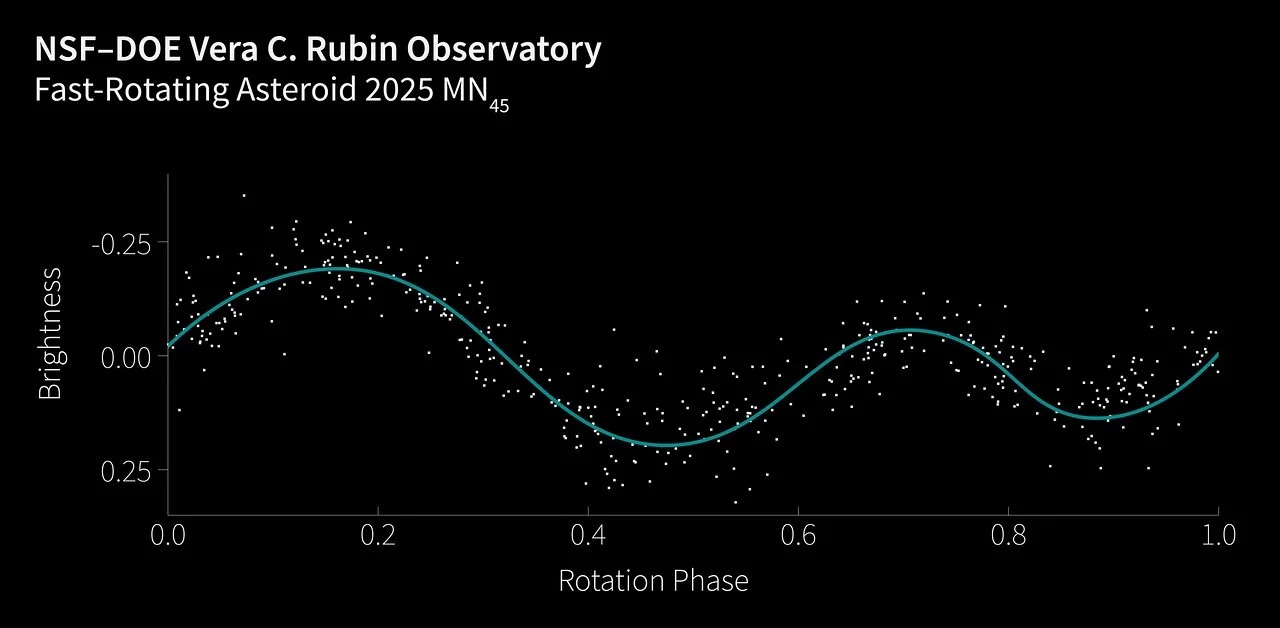
“Clearly, this asteroid must be made of material that has very high strength in order to keep it in one piece as it spins so rapidly,” added lead author Sarah Greenstreet, NSF NOIRLab assistant astronomer and lead of Rubin Observatory’s Solar System Science Collaboration’s Near-Earth Objects.“We calculate that it would need a cohesive strength similar to that of solid rock. This is somewhat surprising since most asteroids are believed to be what we call ‘rubble pile’ asteroids, which means they are made of many, many small pieces of rock and debris that coalesced under gravity during Solar System formation or subsequent collisions.”
Some of the other notable asteroid discoveries include 2025 MJ71 (1.9-minute rotation period), 2025 MK41 (3.8-minute rotation period), 2025 MV71 (13-minute rotation period), and 2025 MG56 (16-minute rotation period).
Scientists expect to uncover more fast rotators when Rubin begins its 10-year Legacy Survey of Space and Time (LSST). These regular observations will gradually take in data and aim to provide pivotal information about the strengths, compositions, and histories of these primitive cosmic bodies.